Update (12:05): Erie police have identified the shooter as Matthew Stone, Sr.
Oddly, the City of Erie police haven’t released the name of the perpetrator of the recent mass familicide in Pennsylvania. We know that it was a 45-year-old male who was related to the victims, but that is all. The police are also withholding other crucial facts. For example, we know that one of the victims was the shooter’s daughter, Angelina Stone, who was pregnant. But we don’t know if her mother was one of the victims.
Angelina Stone (right) with Julius Windham and their baby
The Internet believes it knows who the perpetrator is, but I am waiting for the police to reveal his identity. X is alive, with profiles claiming the man was a white man radicalized by the Republican Party. It may be a white man, but I don’t see how Republican Party politics would radicalize a white man to kill his family. The Republican Party is pro-family.
The shooter’s daughter, Angelina, clearly has black ancestry. Julius Windham, referred to in local interviews by his middle name, Ezekiel, the father of Angelina’s nearly 2-year-old daughter, Amari’anna, who was also killed, is black. Was the shooter black? Was her mother black? Although the police have not revealed whether Angelina’s mother was killed, the Internet is reporting that she is among the victims. But no race has been identified.
I am interested in these questions because social media profiles immediately jumped to the conclusion that, since this was a mass shooting and because white men perpetrate most mass shootings, this must be a white man. Again, the shooter may very well be a white man, but the inference is based on false assumptions.
First, most mass shootings—three or more victims—occur in black-majority urban settings. It is a myth that white men are more often mass shooters compared to black men or that they are statistically overrepresented in mass shootings. Black men are dramatically overrepresented in homicide overall, perpetrating roughly half of all murders in the US. Black men are only 6 percent of the population.
Second, while it is true that white men perpetrated more familicides involving three or more victims, they are statistically less likely to perpetrate this murder type. One-third of all familicides involving three or more victims are perpetrated by black men. This means that black men are drastically overrepresented in this crime type. To be sure, most of those who perpetrate this crime type are white men, but then most men in the US are white. This is a majority-white country.
What is behind social media profiles within moments of the shooting jumping to the conclusion that this was a white man? The posts often come with the gleeful assertion that this was not a black man. They desperately want it to be a white man, not only to smear white men as dangerous (the posts often come with this assertion), but to take the focus off of the overrepresentation of black men in homicide.
When the demographics of homicide are discussed, the accusation of racism hovers above. Yet more than half of all homicide victims are black, and their killers are most often other blacks. Do the victims not matter because they are black? They seem to matter when the perpetrator is white. But white-on-black homicide is rare. Why are progressives so determined to selectively obscure the race of killers at the expense of the race of their victims? Why do they immediately presume a mass murderer is white or feel relief when he is not a black man? I didn’t make this political. I am addressing the politics of the phenomenon.
I also have a moral concern. How are we going to confront the pathologies of urban black neighborhoods if we make it a sign of racism to talk about racial demographics of serious crime? The fact that black men are overrepresented in homicide is a problem that the nation must address. We must talk about this for the victims’ sake. Their lives matter. We cannot ignore them because progressives find the facts inconvenient.
For several decades, earlier in my academic career, I followed the evolution of white supremacy and its numerous manifestations. I have two bookshelves devoted to studies of white supremacy and antisemitism. I turned my attention to other matters over time; however, the rise of antisemitism has brought me back to the subject, and recent interactions on social media knocked off some of the rust on my knowledge base.
One strand of white supremacy I have encountered lately is Christian Identity (not to be confused with Christian nationalism or evangelical Christianity). In this essay, I briefly explore Christian Identity and its affinity with Nazism, as well as its affinity with Islam. Considering the threat Islam poses to Christianity, observers may find it odd that some Christians would align their politics with those of Muslims. The heart of the convergence is virulent antisemitism.
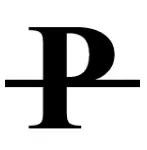
A Christian Identity symbol
Before turning to the Christian Identity worldview, it is useful to note where one is most likely to encounter Christian Identity adherents. Christian Identity is mostly found in the Pacific Northwest, especially Idaho and neighboring areas (Northern Idaho became a major center through Richard Butler’s Aryan Nations compound). However, it is also found in the Ozarks and the Midwest, including parts of Arkansas, Missouri, and surrounding states, where Identity churches and ministries have operated. Christian Identity adherents also dwell in Appalachian and Southern regions. Small groups have been documented in states such as Georgia, Kentucky, and Tennessee.
What is Christian Identity doctrine? Emerging in the United States during the twentieth century from earlier British Israelism, the movement teaches that white Europeans and their descendants, rather than Jewish people, are the true heirs of the biblical Israelites. Its adherents claim that the ancient Israelite tribes migrated into Europe and that biblical promises concerning Israel therefore apply to white people.
Within this worldview, Jews are falsely identified as God’s chosen people, and this alleged deception is often attributed to Satan. Some adherents identify Jews with the biblical tribe of Judah while denying that they are the legitimate heirs to God’s promises; others reject the claim that Jews descend from the ancient Israelites altogether. The doctrine thus constructs a racial and theological opposition between white Europeans, portrayed as the true Israelites, and Jews, portrayed as impostors or enemies of God’s plan.
Where do Christian Identity adherents get this idea? Careful Bible readers will recall that, in 1 Kings 12, the ancient Kingdom of Israel split into separate kingdoms around 930 BC, following the death of King Solomon. Most of the northern tribes rejected Solomon’s heir, Rehoboam, and established a separate kingdom, known as the Kingdom of Israel, under King Jeroboam I. The southern kingdom, known as the Kingdom of Judah, remained under the House of David, with Jerusalem as its capital, and was associated primarily with the tribes of Judah and Benjamin.
Christian Identity doctrine takes the biblical account and builds a racial narrative around their separate histories. After Assyria conquered the northern kingdom around 722–720 BC, biblical tradition came to know the northern tribes as the “lost tribes of Israel.” Christian Identity adherents claim that these tribes migrated across Europe and eventually became the ancestors of white Anglo-Saxons and other northern Europeans.
Christian Identity is ideological, not historical. Whereas Judaism and mainstream Christianity understand the biblical narratives within their historical (and theological) contexts, Christian Identity adherents use them to construct a racial hierarchy. This hierarchy must presume that Jews are not white. It must also reject the Jewish people’s historical connection to ancient Israel. To reach these conclusions, adherents reinterpret biblical passages to establish the supposed superiority of white people over other racial groups.
The involvement of Jews in civil rights and other liberal causes is interpreted as a plot to corrupt the white race. As readers will know, Christians of this persuasion associated Jews with the evils of communism. This is one of the things that separates far-right antisemites from the antisemites in the popular progressive movement, who associate Jews with the evils of capitalism. These differences do not obviate the political convergence of the far right and far left. Antisemitism is the strong core that unites them.
A Christian Identity symbol: The Phinehas Priesthood
Readers will note the significant ideological connection between Christian Identity and Nazism, particularly through racial antisemitism and the belief that Jews are the enemies of the white Christian world. What distinguishes Nazism from other forms of fascism is the centrality of antisemitism and the belief that Jews constituted a racial enemy responsible for Germany’s supposed decline. The America Firsters who reject the populist-nationalism of the MAGA movement work from this assumption. Some America Firsters are Christian Identity, but all of them are antisemites.
Antisemitism is also the source of Nazism’s historic affinity with Islam. Like Hitler and the Nazis, Muslims blame Jews for the problems in the Arab Muslim world. This brought them into a coalition with the Third Reich. Christian Identity carries forward Hitler’s vision of a Jew-free world. To clarify, Christian Identity did not originate with Nazism; it preceded National Socialism. And, of course, antisemitism in the Islamic world preceded Nazism. But all that is neither here nor there, since all three forms of hatred are founded upon anti-Jewish hatred—and the structure and content of that hatred are essentially identical. The convergence is organic.
Obviously, Christian Identity beliefs do not reflect mainstream Christian theology. Nor do these beliefs accurately depict biblical history. To put the matter bluntly, Christian Identity is cracked; one can easily debunk its claims. The claim that white Europeans are the true Israelites is not established by biblical references to the twelve tribes (or variations in their number), by the history of the word Jew, or by credible historical evidence. But historical accuracy is not important to white supremacists (nor is scientific accuracy with respect to the race question). The distinction between ancient Israelite identity and later Jewish identity is necessary to a racialized narrative that denies Jewish historical belonging and privileges white ancestry—a narrative that must deny Jewish whiteness or the fact of Jewish ethnicity (Jews are racially Caucasian and a distinct ancestral group organized by matrilineage).
Consequently, the movement must be understood not simply as an alternative interpretation of Christianity, but as a form of religiously framed white supremacy. One can suspect Christian Identity belief in the fact that its adherents promote conspiracy theories about Jewish influence over financial institutions, governments, and the media. This is what knocked the rust off my white supremacy knowledge base. I am seeing conspiracy theories about Jewish influence everywhere on social media. To be sure, conspiracy theories about Jews also indicate other worldviews—Islam and Nazism being two obvious examples. Isolating Christian Identity belief comes by paying attention to the specific Biblical interpretation the antisemite is working from. Once enough has been revealed through interrogation, then a diagnosis can be made.
As noted at the outset of this essay, one of the more interesting pieces of today’s antisemitic frenzy is the affinity between some Christians and Muslims. The point of overlap arises most clearly with Islamist political movements that define Jews or Zionism (i.e., Jewish nationalism) as a fundamental enemy. Christian Identity and Islam converge in their shared hostility toward Jews, Israel, and what they portray as Jewish influence in world affairs. This aligns them with street-level progressivism, which is profoundly antisemitic, a sentiment deepened by left-wing Islamophilia. Antisemitism makes for strange bedfellows!
* * *
I cannot leave this essay without noting a specific historical example of the affinity between Christian Identity and Islam in the United States: The Nation of Islam (NOI). NOI is a black nationalist religious movement that promotes racial separatism and antisemitic teachings that closely resemble Christian Identity’s claims about Jews, Satan, and illegitimate Jewish identity. Cameron Rowlett’s 2019 article, “In God’s Own Image: Race, Politics and Millennialism in the Nation of Islam and Christian Identity Movement,” explicitly compares the two movements, identifying racial separatism, racialized religious identity, and apocalyptic expectations as areas of overlap.
Although the connection here is more about shared belief, there are direct points of contact between white supremacists and NOI. The American Nazi Party leader George Lincoln Rockwell was invited to speak at a Nation of Islam Saviours’ Day convention. Tom Metzger attended a Nation of Islam rally in San Diego and donated money to NOI on behalf of his organization. Years ago, some 200 white supremacists gathered on a farm roughly 50 miles west of Detroit and expressed support for the Nation of Islam. The event followed contact between NOI leader Louis Farrakhan and Metzger. Readers should know that Metzger founded White Aryan Resistance (WAR). He moved in the same circles as Aryan Nations, led by Richard Butler, which was closely associated with Christian Identity theology.
* * *
Perhaps not incidentally, in antiquity, arya, meaning “noble” or “dignified,” was a cultural and linguistic self-identifier used by ancient Indo-Iranians, including the people of the Vedic sub-continent and ancient Persia. The word Iran literally translates to “land of the Aryans.” It might strike the reader as odd that white supremacists would adopt Aryan for their identity. Ironically, it is an admission that Irans are, in fact, white. Since Jews originate in the Middle East, why are they not also considered white? White supremacists twist themselves into knots attempting to reracialize the Jews. It is an attempt to turn the religious differences between Jews and Christians into a genetic reality. It also enhances the affinity between far-right Christians and Muslims. Thus, the hatred of Jews by some Christians and almost all Muslims becomes a war between Caucasians and the common racial enemy—the Jews. This is an earthly manifestation of the spiritual war between God and Satan.
* * *
It is troubling that, all these years later, we find the convergence achieving broad-based support for anti-Jewish antipathy not only on the far right, but on the far left. It is also troubling that, while the mainstream right understands the problem and has purged its ranks of antisemites, the mainstream left, either explicitly or implicitly, by failing to condemn the antisemites in its ranks, has not followed suit.
Just last night, in a debate between Democratic candidate for Senate, Abdul El-Sayed, and his Republican opponent Mike Rogers, El-Sayed refused to acknowledge that Iran poses a greater threat to world peace than Israel. The correct response would have been to correct the premise of the question: Israel presents no threat to world peace. A nuclear-armed Iran is an existential threat. Iran seeks terrible weapons to bring about the apocalypse. El-Sayed dismissed the question altogether. Yesterday, this would have immediately disqualified him as a candidate for high office in a free country. Today, he is leading Rogers in public polling.
One may identify three positions regarding freedom of conscience. First, the standard liberal position is one of tolerance. For the liberal, a person who believes a thing is free to do so as long as what he believes does not limit another man’s freedom. A second position, which I characterize in a moment, holds that a person who believes a thing is not free to do so. He must either never say he believes the thing or, if he openly expresses that belief, he must be suppressed. The third position is that those who do not believe the thing must be compelled to do so. If they do not, they must face consequences.
Let’s use Scientology as an example. According to this belief, at some point in the distant past, alien beings called thetans were scattered across the universe, and some wound up inside each of us. A technique called auditing reveals their presence. Although the thetan is unobservable, it is real to the person who believes in it. The standard liberal position is to tolerate the Scientologist. Insofar as others are unaffected by his belief, the man is free to believe in thetans if he chooses. For those who assume the second position, the man should not be free to hold this belief, and society must therefore suppress him. In the third position, all people must subscribe to Scientology, and those who do not must face the consequences of their disbelief.
One can replace Scientology with Islam, transgenderism, or any number of beliefs and practices, and the same three situations obtain. Let’s use the queer doctrine to illustrate. Queer doctrine involves the belief that gender identity is something inside of us that must be discovered and affirmed. For the transgenderist, gender identity, a subjective thing, may not align with the person’s sex. Because it is unobservable, gender affirmation is necessary to reveal one’s true gender. Gender identity is perfectly analogous to the Scientologist’s thetan or the Muslim’s soul.
The standard liberal position is to tolerate the trangenderist. A man is free to believe he is a woman if that’s what he chooses—as long as his belief makes no demands on those around him. Those working from the second position say the man should not be free to believe this, so society must suppress him. In the third position, all men must subscribe to the queer doctrine and its rules, and those who don’t must face the consequences for their disbelief and refusal to participate in queer norms.
Two of the three positions involve a specific type of coercion known as offensive force. One might think of this type of coercion as aggressive. In the first (the second position described above), people are punished for what they believe. In the second (the third position described above), people are punished for refusing to believe something. Both positions reduce to a single standpoint: authoritarianism.
The first position, which may involve a form of coercion known as defensive force, is the only one in which a person is free to believe what he will—or not believe what he won’t. If coercion is deployed, it is to protect freedom of conscience. Coercion is not used to force belief upon or from others.
The first position, defined above as the standard liberal position, sometimes called libertarianism, is the only standpoint that allows for personal liberty, and the only one in which coercion is rationally defensible. The rule is simple: compelling belief among others involves offensive force, and is thus aggression; deploying force to prevent others from compelling speech is defensive—and necessary for the sake of liberty.
Most people who died with COVID (SARS-CoV-2) also had other conditions. The Centers for Disease Control and Prevention (CDC) noted that approximately 6 percent of certificates listed COVID as the sole condition. What other conditions were present among the rest of those who died? Diabetes, frailty, heart disease, respiratory conditions, etc. Official guidance treated COVID as the underlying cause when it was thought to have initiated or significantly contributed to the fatal chain of events. However, this practice overcounts deaths in a high-comorbidity syndemic. It is a judgment call, and many things can affect judgment.
Researchers at Stanford University analyzed 57 million US death certificates. They found that reclassification almost doubled COVID assignments, while classifications that weight multiple listed causes (rather than assigning 100 percent of the death to a single underlying cause) reduced the COVID burden by 44–63 percent. In other words, around half of reported deaths were due to other factors.
Another study by Stanford researchers, “Large-scale assessment of socioeconomic, demographic and health system structures with US county excess mortality, 2020-2024,” concluded that the true pandemic burden of COVID-19 in the US for 2020–2023 was likely less than half—or even around a third—of the officially assigned deaths. They estimate around 100,000 deaths under age 65 and 300,000 among those 65 and over, for a cumulative total on the order of around 400,000.
When one considers years of life lost (many decedents were elderly with limited remaining expectancy—indeed, the average age of COVID deaths was well above the average life expectancy), as well as whether excess mortality itself includes substantial indirect effects from responses rather than the virus alone, the death toll usually cited is almost certainly exaggerated by a considerable amount.
Considering all these matters, the death toll was closer to a few hundred thousand direct COVID deaths rather than the official one or more million. Coding practices, multimorbidity weighting, and the distinction between deaths primarily caused by the virus versus those in which it played a lesser or incidental role drove the overestimate. But that is not the only driver of the overestimates. The profit motive played a significant role. And politics. The pandemic response was a power grab by the corporate state.
When confronted with the Stanford studies, defenders of the pandemic response pivot to excess deaths. Excess deaths measures are purported to capture direct COVID deaths plus indirect effects (overwhelmed health systems, delayed care for other conditions, behavioral changes). The public is told that this makes excess death measures more comprehensive than reported COVID counts.
Of course, excess deaths do not comprise a pure measure of SARS-CoV-2 fatalities. Methodological choices matter. Those concerns aside, estimates for excess deaths for the first full pandemic year (March 2020–February 2021) indicate around 656,000 people died with COVID. The second year statistics are somewhat lower, around 586,000. This yields a total of 1.2 million excess deaths for the two years.
However, even if one were to accept the numbers, it is rational to suspect that a sizable share of excess deaths, especially early on, may have stemmed from pandemic responses or other causes rather than the virus itself. Meta-analyses of invasive mechanical ventilation (IMV) outcomes in COVID patients typically report case-fatality rates around 45–52 percent overall (higher early in the pandemic and in older patients). By contrast, mortality among non-ventilated hospitalized COVID patients was substantially lower. Ventilator-associated pneumonia (VAP) was a problem.
Moreover, early caution against routine corticosteroids contributed to many deaths. When doctors finally administered corticosteroids, they reduced 28-day mortality by about one-third among patients on IMV. The WHO issued strong recommendations in September 2020 for systemic corticosteroids in severe and critical COVID-19, but retained a conditional recommendation against them in non-severe disease. By then, many patients had died.
If COVID deaths are exaggerated by death certificate processing, which the evidence indicates they were, then the excess deaths beyond what can be attributed to COVID, and even COVID-related measures, indicate that something beyond COVID and COVID-related measures killed hundreds of thousands of people in the aftermath of the Pandemic. Indeed, excess deaths did not return to normal in the two years (2022-2023) following the first and second years of the pandemic. It was not until 2024 that the numbers returned to normality (assuming the pre-COVID baseline). What occurred during this period?
I think readers know. The rise and decline of the mRNA jab. Confirmed and well-documented risks of the mRNA COVID-19 vaccines (primarily Pfizer-BioNTech and Comirnaty and Moderna and Spikevax) are associated with serious adverse events. Large-scale monitoring systems (VAERS, VSD, international cohorts covering tens to hundreds of millions of doses) have characterized these over years of use. Myocarditis and pericarditis (inflammation of the heart muscle or its outer lining) are established serious risks linked specifically to the mRNA platform.
Prominent critics of the mRNA platform include cardiologists such as Peter McCullough and Aseem Malhotra, early mRNA researcher Robert Malone, and others who have argued that the absolute risks of serious adverse events (especially cardiovascular ones) are higher than official figures suggest. Moreover, myocarditis cases are more frequently severe or leave lasting damage than commonly acknowledged by the industry. Re-analyses of the original Pfizer and Moderna randomized trials (notably Fraiman et al.) found an excess of serious adverse events that, in their view, approached or exceeded the reduction in COVID hospitalizations in the trial populations. In other words, Big Pharma knew the risks and concealed or obscured them.
The dark reality of the pandemic response is revealed by the broader signals of excess mortality, sudden deaths, or multi-system harm after rollout that are under-investigated or suppressed: autopsy case series, ambulance data, all-cause mortality trends—that is, evidence of net harm in certain groups. Additional concerns include residual DNA contamination, prolonged spike protein expression, frameshifting, lipid nanoparticle effects, or potential for autoimmune or oncogenic risks.
* * *
There’s another matter related to the pandemic response worth commenting on. This is the question of masking. You may have noticed that people are still masking. If the threat of COVID has passed, then why do people continue to wear masks? Moreover, since it has become widely understood that cloth and surgical masks provide little to no protection from viruses, what is the point of wearing masks even if the COVID threat were elevated?
In a late September 2026 episode of Real Time with Bill Maher, in the context of the ongoing controversy at a Massachusetts lesbian bar (Last Ditch) that faced intense backlash for making one night a week mask-optional in 2026, plus broader observations of people still masking at DSA meetings and on the street years after the acute pandemic phase, Maher asked neuroscientist Andrew Huberman to explain.
Huberman charitably responded that while some have medical reasons, most do not. “It’s a political statement,” he said. He linked it to symbolism (referencing Banksy-style protest imagery) and noted masks also serve as a form of anonymity, as well as social signaling. Masks are tribal; they signal affinity. Huberman is not speculating. There is substantial evidence that mask-wearing became (and in some circles remains) a form of political/social identity signaling rather than purely a health decision.
During the pandemic, multiple studies documented strong partisan divides on the question. Mask use correlated more strongly with political affiliation than with local COVID severity or policy. It functioned as a visible social identity marker: people cooperated more with those who matched their masking behavior, with Democrats and Republicans showing clear differences in attitudes and compliance. Mask-wearing signalled loyalty to progressive ideology, where faith in medicine is of a religious quality. We saw that as well with receptivity to mRNA jabs. Progressives marched their children to doctors’ offices and pharmacies to get their children jabbed and shared pictures of the moment on social media. Dr. Anthony Fauci became a saint.
Medical reasons still exist for a minority, such as immunocompromised people and specific high-risk situations (this presuming that masking offers protection). To clarify, then, the claim is not that no one has a health reason, but that for many visible, ongoing cases in non-medical contexts, the primary driver is political and symbolic. In progressive or left-leaning activist spaces (e.g., DSA meetings, identity-focused venues), continued high rates of masking long after mainstream public health guidance shifted and excess mortality largely normalized cannot be explained solely or even mostly by individual medical risk. It aligns with it becoming a tribal or ideological marker—similar to other visible signals of group belonging.
We see this in the rationalizations of left-wingers when the COVID pandemic comes up for discussion. I was told in a recent encounter that the BLM protests were not problematic, despite churchgoers being kept from services, because a large majority of protestors were wearing masks. The claim about mask-wearing is true. But for what purpose were BLM protestors wearing masks? The type of masks worn is revealing. For the most part, protestors wore bandanas or cloth masks with political slogans on them (“Black Lives Matter” and, ironically, “I can’t breathe”). Surgical masks appeared much less often (in fact, the government dissuaded the public from wearing surgical masks because of shortages), and N95/respirators rarely appeared.
Given that bandanas, cloth masks, and surgical masks do not protect the wearer from transmitting and receiving the virus, what other function might masks serve beyond signalling tribal affinity? As readers know, the protests were not peaceful, but riotous. Rioters often wear masks to conceal their identity. Taken together, shared anonymity and tribal affinity represent a unified political front. BLM was a color revolution, its purpose: to disorganize civil society. Those who continue to wear the masks several years out from the pandemic indicate the continuation of the political project.
* * *
The politics of masking matches broader patterns of how pandemic behaviors became and remain polarized and sticky as cultural signals. Bringing this back to the first part of this article to illustrate, those who need the COVID Pandemic to be as bad as it possibly can be will treat the CDC estimate of more than one million people who died from the virus as if they are sacrosanct. They need for there to be millions of deaths to justify authoritarian desire.
One will find the attempt to educate them about statistics futile. What one is likely to get instead is a challenge: “What would you have done differently?” Not that what I would have done matters in clarifying facts, but I do know what I would not have done. I would not have locked down society, forced people to wear masks and socially distance, derailed the developmental trajectory of millions of children, or made continued employment or organizational presence dependent on whether the individual was jabbed with an experimental mRNA vaccine we knew years earlier causes systemic inflammation throughout the body.
Achieving herd immunity early in the pandemic would have solved the matter. My pandemic plan would have started there: let the young and healthy go about their lives as they normally would. Most cases of infection were asymptomatic. After all, SARS-CoV-2 is a coronavirus, one of the three virus types associated with the common cold. Over time, the more lethal form would have attenuated. All the calamity associated with lockdowns and all the rest of it would have been avoided. Yes, people would have died (people died anyway), but this is nothing new in history when a novel virus spreads through a population. We would have avoided all those deaths caused not by the virus but by the medical industry’s response to it.
Contemplating deaths in the name of freedom, I am reminded of Patrick Henry’s rousing March 1775 speech in which he concluded with: “What is it that gentlemen wish? What would they have? Is life so dear, or peace so sweet, as to be purchased at the price of chains and slavery? Forbid it, Almighty God! I know not what course others may take; but as for me, give me liberty or give me death!”
* * *
One last thing. In the early days of COVID-19, Democrats fought against a travel ban. Thousands of Chinese were arriving in the US daily on planes originating in the very place where the virus first appeared, yet Trump was smeared as a racist for restricting travel from China. Remember that? Don’t ever forget it. And don’t ever forget that churches and schools were shut down while rioters burned buildings and cars and assailed police and civilians, their actions valorized by Democrats.
This article is an elaboration of last week’s article, Is the DSA Socialist or Communist—Or Neither? That article was concerned with semantics. In today’s essay, I show why it’s important to understand what words mean and what those who use them really mean when deploying them. When the meaning and purpose of words are made clear, so are the politics they convey.
Democratic Socialism is not socialism. Socialism is worker control of the means of production. Democratic Socialism is in fact corporatist. Corporatism is not worker control, but a tripartite arrangement with corporations at the top of the hierarchy of power, working through the state they have commandeered, with labor contained by co-opted private sector unions, joined by the public sector unions formed to entrench the administrative state.
In its extreme manifestation, corporatism is fascism. The name of the philosophy underpinning National Socialism, i.e., Nazism, was not accidental. However, as I have noted before, the name is misleading (see Understanding the Deep Structure of Fascism). National Socialism was not nationalist in the way Republicanism is nationalist. National Socialism was globalist in ambition. Moreover, it was socialist not in the sense of industrial democracy, but in the sense of collectivism organized by the corporate state.
This is why Hitler sought a pan-European superstate and a pan-European military apparatus. Eventually, he sought a global order organized by corporatist logic. Regionalism was a step toward globalism. This was Hitler’s ultimate goal: a New World Order under the command of banking and corporate power. What is the European Union? It is openly a pan-European superstate based on corporatism under the control of transnational banks and corporations. What is NATO? A pan-European military apparatus. The European Union is a manifestation of regionalism with the end goal of globalism. Who was at the hub of the Nazi superstate? Germany. Who is at the hub of the EU superstate? Germany.
In The Crisis of Democracy: On the Governability of Democracies, published by the Trilateral Commission’s Task Force on the Governability of Democracies, globalists explained that Trilateral world consists of three major centers of advanced industrial democracy: North America (with the United States in the lead), Western Europe (with Germany at the center), and the sphere of Japan, which was then a major power. Japan was then the hub of industrial power in East Asia. The report treats these three regions as interconnected political and economic centers whose governments faced related problems of democratic governance during the 1960s and 1970s. The goal was to align elites in their efforts to marginalize democratic-republicanism and contain liberal freedoms.
The Crisis of Democracy was not an obscure document. The Trilateral Commission was not a marginal or secret society. It was founded in 1973 by David Rockefeller to openly bring academics and economic, media, and political elites together for world planning. Now should I refer to the organization in the past tense; the Trilateral Commission is still in operation. It is joined by other world-planning organizations, such as the World Economic Forum. This network of elite organizations does not merely recommend to elites how they should govern the world population. The Trilateral Commission groomed elites, such as Jimmy Carter and George H. W. Bush, to carry its agenda into public office and restructure the world according to its agenda.
The governability of democracies has long concerned authoritarian-minded elites. The National Socialists of Germany suppressed free speech and political opposition, commandeered the mass media, and organized public education—including the university system—according to the ideology of National Socialism, i.e., the pan-European ideal and, eventually, a New World Order. The Democratic Socialists of Europe today likewise suppress free speech and political opposition. They have commandeered the mass media and organized public education—including the university system—according to the ideology of Democratic Socialism, i.e., the pan-European ideal and, eventually, a New World Order.
The problem with Nazism was that it was open about its ambitions, and its authoritarianism was obvious. The dictatorship of Hitler and his one-party rule announced the presence of totalitarianism and attempted to legitimize it. Too much, too soon, and the wrong strategy. The European Union attempts to solve this problem by dissimulating authoritarianism, dressing it in democratic clothing. To be sure, there is a plurality of political parties, but the ones that have heretofore dominated the political landscape are unified in the goal of entrenching corporatism. The parliamentary systems of Europe, which lacks a bulwark against the rise of authentic authoritarian elites, makes it possible for a coalition of political parties to act as a unified force, dissimulating their authoritarian via the rhetoric of democracy.
When elites paint Marine Le Pen and the National Rally of France, and Alice Weidel and Alternative for Germany (AfD), as fascists, they are inverting reality. They do the same thing with Donald Trump and the MAGA Republican Party. They portray movements and parties rooted in genuine national sovereignty as their opposite to make corporatism appear to be the democratic force. This is why they smear nationalists and patriots as “authoritarian,” “fascist,” etc. They’ve even managed to make nationalism an objectionable word, when nationalism is really simply the doctrine that a particular people should have a nation of their own.
The National Socialists also erred in attempting to pull the indigenous populations of Europe into their superstate by purging Europe of non-Germanic ethnic groups. Confronted by obvious racism and denationalization, Europeans resisted and Hitler was defeated. After Hitler’s defeat, the corporatists changed strategies. Instead of organizing the indigenous populations to destroy liberal democracy and national sovereignty through ethnic cleansing, the corporate elite today disorganize the indigenous population through mass immigration, flooding the zone with Third World ethnicities. Turning European antiracism against Europeans themselves, they convinced enough of the indigenous populations to feel guilt sufficient to prevent widespread defense of their indigenous cultures.
Beneath the different strategies is the same goal: to entrench a pan-European corporate state that aims to incorporate the Western Hemisphere into the global economy to create a New World Order. Just as National Socialism was a ruse to manufacture consent, so is Democratic Socialism a ruse for the same purpose. Along with making nationalism as dirty word, obscuring racism by rebranding it “antiracism” was a spectacular propaganda achievement. Freedom-lovers weren’t the only ones reading George Orwell.
The Democratic Party is the entity on this side of the Atlantic that is aligned with Democratic Socialism. The goal of the Party is to denationalize the United States. Think about it. Why did the Democratic Party and the Republican Party, under the control of neoconservatives and Trilateralists, push NAFTA, etc.? Why did both parties before the rise of MAGA invite China into the world economy to take control of global supply chains and dominate consumer markets? Now you know why—if you had already figured this out.
The Democratic Party is working to undermine the American Republic. The Party is the main player in the transnationalist project. The Democratic Socialists of America is the openly progressive arm of the Democratic Party that pulls a portion of the masses into the gravitational pull of transnationalism. It is corporatism’s popular front. Progressivism is the praxis of corporatism. The function of progressivism is to normalize the administrative management of social life. It is totalitarian in logic.
Putting Democrats back in power advances the transnationalist project. Democrats are presently only distancing themselves from the DSA to maintain the illusion that the Party represents the interests of ordinary Americans. Corporate elites—the same ones that bankroll and organize the street protests the mobilize Hoffer’s true believers—manufacture consent by playing both sides of a divide that have not figured out the scheme. They then marginalize those who have figured it out by painting them as extremists.
Elites also co-opt elements of the conservative movement and effectively pull them to their side. Antisemitism and Islamophilia—which exist on the left and the right—plays a major role in this strategy. This explains politicians like Marjorie Taylor Greene and Thomas Massie. This is why social media influencers like Tucker Carlson champion Islam and rail against Trump, MAGA, and Israel. They are joined by left-wing influencers such as the demagogues in The Young Turks.
See how it works? All one needs to do is study patterns and historical trajectory to see the scheme. I have attempted to falsify my interpretation of the patterns and history and I can’t. This is what is going on.
This essay does several things. First, it explains the difference between communism and socialism and their relationship to one another. Second, whatever their differences, it clarifies the problem of collectivism in complex societies. Third, it details the self-described character of the Democratic Socialists of America (DSA) using these understandings. Finally, it analyzes the DSA’s role in Democratic Party politics. Since the Democratic Party is a bourgeois party, why would it associate with a political organization actively promoting socialist ambition? This association raises a question about the actual function of the DSA and other openly socialist organizations in corporate state society. Are these organizations really socialist? Or are they something else?
* * *
Semantics are important. Communism is not socialism. Socialism is a social formation in which workers control the means of production through a proletarian state. To the extent that private firms and therefore a capitalist class exist, they are subjected to law and policy determined by a committee of the working class. By contrast, communism is a classless/stateless society.
In the above sense, communism is no different from anarchism, as Alexander Berkman told us. At least in the end that they seek. Anarchists and communists disagree over the means to achieve that end, and this disagreement is what differentiates them. Communists do not think man gets to a classless society by overthrowing the state. Instead, workers must seize and command the state, using it to dismantle the class structure. At this point, the state will wither away, and the common goal will have been achieved. Anarchists believe class relations exist as long as the state remains, since it is an instrument of the ruling class; therefore, abolishing the state removes the instrument of class power that perpetuates its existence.
Both anarchists and communists see the future society as, in principle, the same society in which prehistoric man lived. At least that is the framing. Karl Marx and Frederich Engels describe the original society as “primitive communism.” Such societies were clan-based and family-centered. Admitting to relatively insignificant or symbolic status hierarchies, these societies were otherwise democratic and egalitarian. With the absence of class relations in prehistory, no state apparatus was required. Everybody had the same interests and preferences and, moreover, shared the same worldview (its beliefs, norms, and values).
For Marxists, the state (as well as organized religion and the patriarchy) comes into existence with the emergence of segmented social formation. In segmented societies, people must navigate a complex system of exchange and production relations, as well as social divisions. These divisions come with competing interests and perspectives. This complexity requires law, governing institutions, and a formal social control apparatus. The emergent situation has been true in many places for thousands of years. Today, it is true almost everywhere.
The reader will note that I have strayed from the theory that reduces social relations to class relations. There is an important reason for doing this. Seizing the state and dismantling social class will not alter the complexities of modern life. Complexity requires a greater level of social organization. The state will not wither away with the abolition of social class. The proliferation of social divisions since the emergence of social class make the complexity of the situation irreducible to property relations. Hence the need for coercive institutions persists in the wake of their abolition.
As noted, socialism puts ownership of the means of production in the worker’s hands. This requires coordination and planning, i.e., bureaucratic administration of the population. Socialists will claim that, in ideal terms, the state is proletarian; it is no longer the bourgeoisie’s purview. For communists, socialism is seen as a necessary step towards a stateless society after the bourgeoisie is abolished as a class. However, beyond theory, in part for the reason stated above, it never works like that.
But there is another reason socialism is not a precondition to communism: accepting the complexities of modern life, the theory must also presume that all workers have the same interests and preferences—and share the same beliefs and commitments. Since this is not true of large, diverse populations, this requires shaping individual minds to align with a collective worldview. This raises two questions: Whose worldview? Furthermore, is it possible to bring all the minds of millions to a singular worldview?
The answer to the first question, which I will come to, is obvious. The answer to the question seems just as obvious. Because some will always resist such an alignment, since they do not prefer it and their preferences are stubborn, especially those that are rooted in natural history, alignment requires coercive institutions. Those who prefer liberty over collectivism represent a discordant element in the attempt to impose a singular worldview.
Many—if not most—individuals want to be free from intrusive government. They prefer market-based systems; they believe (correctly) that such systems maximize liberty and the pursuit of self-actualization. Marx argues this is because of socialization in a world shaped by bourgeois logic. Since capitalists rule over others, their ideas are the ruling ideas. The masses have been conditioned to think in bourgeois terms. Replace the present ruling class, and new ideas will inhabit mass consciousness. Here is the answer to the first question: the new ideas are those of the communist.
This ignores another crucial fact about humans. In addition to the love of liberty among many, some are overly ambitious and seek not just the good life, but also power over others. This problem is not exclusive to capitalist society. Thousands of years of history make clear that the overly ambitious individual is a perennial problem. Under primitive communism, the tribe could bring such persons to heel (and did so without law and state). The tribe knew who the overly ambitious were and could put them in their place. But in large and complex societies, the few become many, command enormous resources, and move beyond awareness. The power dynamic becomes dissimulated in vast, impersonal social relations. Therefore, the question is not whether some rule over others, but who rules, and what structures have been emplaced to prevent the rule from becoming totalitarian in character.
Democratic socialists insist that true socialism is democratic, substituting the rhetoric of democracy for socialism to smuggle socialism in under cover of a glittering generality. As a system of individual freedom, democracy remains undefined. Democratic socialists promise freedom, what they describe as liberation from controlling private power. A more thorough-reaching democracy is the goal. Thus, a crucial question to ask here is: what type of democracy leaves the individual free?
If democracy means the right of the individual to have a say-so in the major decisions that affect him (this definition seems reasonable), but not having a say-so over decisions men make that do not affect him (the liberty principle), then man remains free. If the second principle falls to the wayside, then democracy becomes majoritarianism, a situation where the individual is subjected to the tyranny of the majority—not because he is necessarily overly ambitious, as in the tribal situation (and, again, without the means of formal coercive institutions), but because he must be aligned with a plan to administer a complex society.
What will democracy be under socialism? Could it be anything other than majoritarian? It is hard to imagine how. To be sure, a technocratic core could manufacture the appearance of majority rule. It could dress the whims of a governing elite as the common good to which individuals must submit. Indeed, it would have to maintain control over the population. In this case, freedom would be a simulation.
To protect the individual from the tyranny of the majority, which is, in truth, a cover for the overly ambitious few, the individual must have unalienable rights, that is, immunities and privileges that governments cannot intrude upon without rationally justifying limitations. Any limitations on freedom in such arrangements must be for others’ rights under conditions of formal equality. Such a situation is only possible under a republican government governed by liberal principles. These principles preserve individualism among social animals. Individualism, which we grant as a basic human desire, is not possible under any other arrangement. Legal and political arrangements based on these principles allow for the many to check the majority and the overly ambitious few.
I have tried to falsify this proposition. I cannot. I conclude that socialism cannot be reconciled with the demand for a free and open society. Either socialism is, and freedom isn’t, or the other way around. It is not that capitalism does not come with discontents. Inequality, for example, is inevitable. It is that capitalism, for all its flaws, when governed by republican principle, is the only system that allows for maximal personal freedom. Capitalism leaves space for individuals to choose their path in life. Indeed, inequality to a substantial degree is the result of liberty.
This explains why socialism, wherever it has been instituted, has always been illiberal and undemocratic. It’s not because man isn’t doing it right. Socialism always works out this way when it moves from theory to practice. This is the result of natural history. Evolution made people both self-interested and social for reasons of survival. Self-interestedness is not the result of bourgeois indoctrination. Nor is singular social consciousness a thing the organized proletariat can grasp.
Natural history operates via variability in individual attributes in a population, with some being smarter, stronger, faster, and more motivated than others. These differences become more consequential in larger populations. Achieving equal outcomes—the goal of substantive equality embraced by communists—necessitates state control over all aspects of social life. The control socialism necessitates is qualitatively different from the control type required in a market-based economy.
* * *
Marx described the communist motto this way: “From each according to his ability, to each according to his needs.” Many readers will know the motto. But many are less familiar with the socialist motto: “From each according to his ability, to each according to his work.” The socialist motto may at first blush sound rather Protestant, but it is stamped on a society in which private property has been or is being abolished. Socialist arrangements thus preclude the entrepreneurial spirit; the state replaces the exceptional individual. The “dictatorship of the proletariat”—technocrats of the communist party (which becomes the only party)—determines what is produced and who receives the fruit of collective labor. Socialism is necessarily totalitarian.
Marx did not call this phase of social formation socialism. He called it the “lower phase of communism.” That’s known as truth in advertising. The party platform announced in the Communist Manifesto, as radical as it is, is modest given the final destination—it is an initial step to the final solution. Thus, for communists, what we call socialism is a pupal stage in the transition from caterpillar to butterfly. Socialism is not the final destination. It paves the road to communism—which it never does; the state never “withers away,” as Marx promised, for all the reasons I have already explained.
If you examine the DSA platform, it is essentially lifted from the Communist Party platform. As radical (and awful) as it is, it is still modest. This is because it is a means to an end. When the DSA objects to being called communists, they’re being disingenuous. The end goal is communism—at least this is what the rank-and-file hope for. Thus, when Donald Trump calls the DSA communists, he is not wrong, if by using this designation he means to say that this is what the DSA comrades believe.
There’s a reason that actually existing socialist societies are run by parties openly calling themselves communist. Once in power, they openly declare their ambition. But some do not wait to make their ambitions known. For Marx and the First International, they felt it was important to announce this upfront. They sought to haunt the bougeoisie with the specter of communism. The DSA lies about itself.
We don’t need to wait for them to admit to the end they seek. We have history. It’s not just the end that is objectionable—however unobtainable given the complexities of the modern world. The means are more objectionable than the end because socialism is obtainable. One need only study the history of the Soviet Union or the present reality of Red China to know what awaits.
* * *
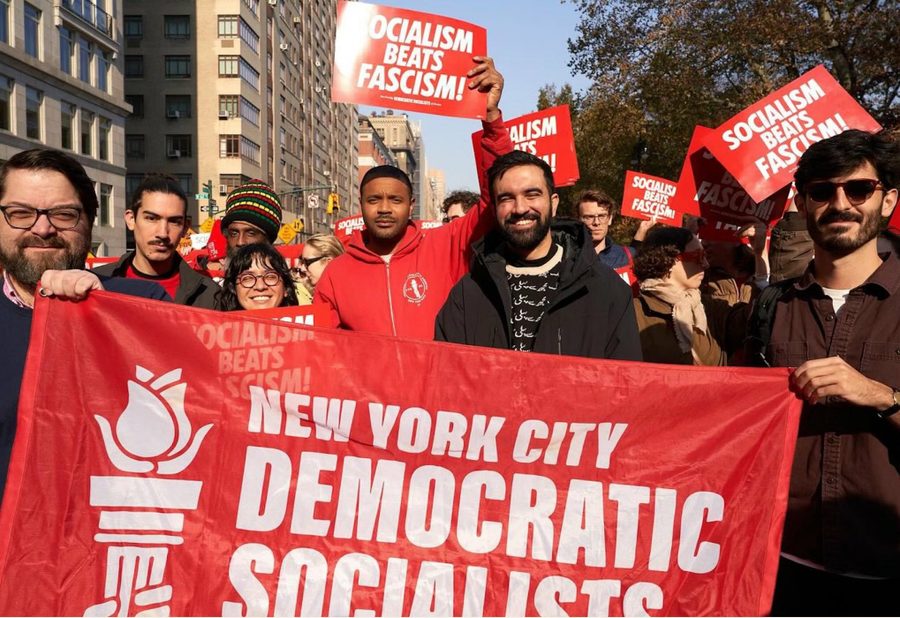
New York City Mayor marching with DSA
However, there’s a twist. All this presumes that those who run the DSA actually seek communism. Moreover, it presumes that socialism is the end sought. That the DSA is joined at the hip of the corporate-controlled Democratic Party—even when the Party keeps the DSA at arm’s length—suggests that the DSA functions to dissimulate corporate power. It is absurd to suggest the Democratic Party is a socialist party. Democrats defend administrative rule not to achieve socialism, but to manage the population and entrench corporate power. So why would they associate with an openly socialist organization?
Is it not obvious? The DSA is not a revolutionary organization but a tool of hegemony. In the early twentieth century, the Italian communist Antonio Gramsci argued that a ruling class maintains power not merely through coercion—laws, police, military force, and the suppression of dissent—but through consent: it persuades subordinate groups to accept the existing social order as legitimate and natural. The ruling class—today, this is the corporate class—exercises cultural and intellectual leadership by shaping institutions such as education, the mass media, political organizations, and religion, thereby influencing what people regard as common sense, desirable, and possible.
This does not mean the masses are simply brainwashed; rather, Gramsci saw political stability as depending on a combination of coercion and active or passive consent, with ruling groups making concessions and incorporating some subordinate interests while maintaining the basic structure of their dominance. Thus, for Gramsci, effective rule involves not only commanding people, but also leading them—winning enough acceptance that the existing order can reproduce itself without constant reliance on force. Progressivism and social democracy are not socialist. They are ideologies designed to disrupt organized socialist sympathies.
The DSA is an arm of the hegemonic structure of the corporate-dominated Democratic Party. The DSA’s relative independence from the Democratic Party gives the Democrats plausible deniability. It keeps a distance to keep those who oppose socialism in the fold. At the same time, it downplays the DSA’s significance, with a wink to those who think the DSA is actually socialist. It need not reject the DSA since the DSA isn’t oppositional—not because the Democratic Party is socialist, but because the DSA isn’t. The DSA is a simulacrum of a socialist organization. It exists to steer those who find socialism appealing to the Democratic Party and rob them of the capacity to disrupt corporate power. The DSA is an instrument elites use to transmit corporate desire in popular terms.
At the core of Democratic politics is the essentiality of administrative rule. Administrative governance reproduces existing illiberal power relations. The DSA provides an ideological framework for people whose preferences conflict with those relations. The DSA deceives the socialist-minded into believing that they are participating in a transformative political project. The end sought is not socialism, terrible as that end is, but the corporate state, which is just as terrible. What the DSA calls socialism is an illusion masking the true collectivism elites are entrenching, namely the corporate state. And the rank-and-file socialist has fallen for the ruse.
The DSA is a method of controlled opposition, a vehicle for hegemonic incorporation. By channeling discontent with capitalism into institutions and political practices that ultimately remain compatible with the existing order, the DSA should be understood as a containment field. The elite need not suppress opposition and alienate millions; instead, they incorporate and redirect oppositional aspirations in ways that help stabilize the very system those aspirations seek to transform. The rank-and-file socialist has been coopted and neutralized. An obstacle has been removed from the path to total corporate power.
In today’s essay, to illustrate a point, I defend a fictional professor named Stephen Amos. Dr. Amos is a tenured faculty member who refuses to use students’ preferred pronouns when they conflict with their biological sex. For dissenting from a queer rule, the university brings disciplinary charges against Dr. Amos.
Dr. Amos is a composite drawn from a universe of real-world examples. His specific discipline is irrelevant to the case; his PhD may be in any field; expertise has no bearing on the fundamental rights to conscience and thought that I defend in this essay. I tell Amos’ story to illustrate the totalitarian desire lying at the heart of compelled speech. Amos is the true victim of discrimination, not the students who wish to compel him to misgender them.
The essay begins by summarizing the facts of the case against Amos. I then clarify civil rights law. Here, in addition to defending Dr. Amos’ right to conscience, I must also contrast the objective, immutable nature of biological sex as a protected characteristic with the ideological foundations of gender identity. I argue that true anti-discrimination protections shield individuals from coercion based on inherent traits; they do not empower one group’s contested beliefs to override another’s right to speak and think on the terrain of observable reality.
Finally, I expose the circular, fallacious appeals to institutional authority, revealing how censors use the ruse of expertise to justify suppressing dissent and free speech. The fictional university cites various organizations to establish as “fact” the “truth” of gender identity. But these citations have no legitimate bearing on Dr. Amos’ case, not merely because authorities have established no truth, but because Dr. Amos is not obligated to accept the citations as true in a free society.
* * *
The fictional Dr. Amos
As a tenured faculty member, Amos enjoys rights beyond those recognized by the US Constitution. He appeals to academic freedom, which allows him to question the objective basis for a demand that he use preferred pronouns. Amos also refuses on First Amendment grounds; he cannot be compelled to obey the university’s arbitrary rule that faculty must misgender students and colleagues.
The university defines transgressing these rules as “misgendering.” Dr. Amos argues that actual misgendering involves using pronouns that do not correspond to a person’s sex, which he (correctly) asserts is an objective, unchangeable reality, one determinable through independent observation and objective confirmation. It is wrong, or at least inaccurate, he argues, to address a man using feminine pronouns, since doing so denies the person’s actual identity.
The demand for preferred pronouns assaults the integrity of truth. The practice essentially requires—he cites George Orwell’s Nineteen Eighty-Four to make his point—that he affirm that two plus two equals five.
Charged with unlawful discrimination, Dr. Amos readily admits that civil rights laws protect groups with distinct or inherent characteristics. Protected classes identified in US statutes and precedent—defined by sex, race, religion, national origin, disability, or age—shield individuals from unfair treatment, harassment, or exclusion based on traits, whether innate or acquired, fundamental to their identity.
The purpose of antidiscrimination law and policy is straightforward: to prevent denial of opportunities or rights based on intrinsic or socially recognized characteristics. Dr Amos insists that he has denied no opportunities or rights to trans individuals. He recognizes their existence and treats such persons the same way he treats all students in his classes—as individuals.
Dr. Amos clarifies that membership in a protected class does not obligate others to adopt the behaviors, beliefs, or practices associated with that class. He uses his go-to example: Neither an atheist nor a Christian is legally required to affirm the truth of Islamic doctrine or participate in Muslim religious rituals because religion is a protected class. One is only obligated to tolerate them.
Refusing to affirm beliefs does not constitute discrimination, the professor continues, since discrimination occurs when someone is treated unfairly because of their class membership. No discrimination occurs when outsiders decline to endorse or perform beliefs or practices associated with that group. Protected status guards against coercion; it does not grant the state the power to compel conscience and speech from those outside the protected class.
Forcing atheists or Christians to affirm Islamic doctrine or ritual is a violation of their civil rights. (For the record, Dr. Amos is an atheist.) By the same token, so is forcing them to affirm a chosen gender identity. A transwoman is still a man, just as is a Muslim man.
Dr. Amos’ arguments notwithstanding, the university pursues their case against the professor, claiming that his refusal to use preferred pronouns amounts to misgendering and therefore discrimination.
Dr. Amos sues, arguing that compelling him to use language that contradicts his understanding of biological reality violates his freedom of conscience—a constitutional right that supersedes university policy. It also violates the principle of academic freedom established by his employment at a university, where the freedom to dissent is essential to the progress of knowledge.
At his hearing before the Committee on Rights and Responsibilities, he compares the demand that he participate in the rituals of the gender identity doctrine to being forced to avoid pork because Islamic law declares it haram. He asks the committee whether a sociologist of religion would be punished for noting the fact, attested to by Islam itself, that Muhammad married a child and consummated the marriage when his bride was eleven.
Noting a sociologist sitting in judgment of him, Dr. Amos points out that Muhammad’s relationship with a prepubescent minor is pertinent to critical inquiry; it prompts discussion of normative variability across cultures and history. Religion is, after all, a social phenomenon, which differs over time and space. Would a student complaint accusing the sociologist of blasphemy cause the university to file charges against the professor for discrimination? Could justice be obtained by having the sociologist apologize to his students and affirm that Muhammad was the most perfect man in history?
Such things are hard to imagine, Dr. Amos suggests. It runs afoul of religious liberty. Likewise, returning to his own case, to affirm the construct of gender identity and observe its pronoun rules is tantamount to forcing him to subscribe to a belief system he rejects and participate in rituals he abhors. He is no more obligated to the rules of the gender identity doctrine than he is to the blasphemy rules of Islam.
Predictably, the university counters that gender identity is not analogous to religion because the distinction between sex and gender is grounded in medical science. It is not a belief system but a material fact (here, they confess to the qualitative differences among categories protected under civil rights law). To be sure, sex, they admit, refers to objective biological characteristics—chromosomes, hormones, and reproductive organs—that categorize individuals as male, female, or intersex. And gender, by contrast, refers to behaviors, expressions, and an internal sense of self that may or may not align with biological sex. But the university maintains that both are real: sex is material and independent of society; gender represents a genuine psychological and sociological reality.
For those who suspect I am constructing a straw man, I am actually steelmanning the university’s position. The subjective construct of gender identity is reified by the doctrine the university accepts as true. Gender identity is not merely real; it is more real than sex. How could it otherwise impose itself on the reality of sex? The biological category must yield to the psychological and sociological reality.
Dr. Amos rejects this framework. He argues that, by the doctrine’s own logic, gender as defined by the queer worldview is not an objective category in the same verifiable sense as sex. Its boundaries and rules are established by ideology rather than universally observable evidence. If one accepts that gender is distinct from sex, it is by definition a different category, one not organized by objective traits, but based on individual assertion, sometimes affirmed by a medical professional (although, according to activists, this is unnecessary).
As such, gender identity cannot generate the kind of civil right that would justify punishing an individual for refusing to affirm it. It falls into the same category as religion or other deeply held convictions. The rights of others are at stake, Dr. Amos points out.
He asks the committee to note a contradiction: if gender identity doctrine is allowed to shape institutional arrangements, would it not have men entering spaces exclusive to women, thus violating the right of both sexes to sex-exclusive spaces? What of their rights? Should a belief system upend an equitable system based on the fact of sexual dimorphism? Must a right established on a material fact bend because of the subjective claims of individuals? How could a man believing he is a woman justify violating the rights of women to the exclusive spaces established based on objective differences between males and females?
“But transwomen are women,” the committee objects. Dr. Amos responds that his fate cannot depend upon a contested claim. Certainly not on a falsifiable one. Compelling him to speak and act according to this ideological framework under threat of discipline is a form of compelled belief—precisely the sort of coercion civil rights law was meant to prevent, not enable.
Punishing him for objecting to the reorganization of institutions or modification of his personal speech acts to align with the gender identity doctrine violates his freedom to speak and publish as determined by the dictates of his conscience. He is not a subject in a kingdom where the truth is determined by the monarch. He is a citizen in a free society. His rights come not from government or men, but from laws of nature, as affirmed by the Declaration of Independence and specified in the First Amendment.
This is the stuff of foundational law. The authority of the law is not imposed by an ideology, but by an external truth, one determinable by induction from observation, as well as by deduction from first principles. Even if he appealed to the transcendent authority of God, that appeal itself is a liberty protected by civil rights. If the institution makes a similar appeal, that won’t fly. The First Amendment protects individuals, not institutions. At least not public ones.
Dr. Amos argues that sex is a protected class precisely because it is an objective, immutable reality grounded in anatomy, chromosomes, and reproduction. This is the paradigm of a civil right since it rests on material grounds; it is not a social construct but an observation. Using pronouns that accurately reflect a student’s sex cannot, therefore, constitute sex-based discrimination; it’s an affirmation of the very characteristic the law exists to protect.
Gender identity doctrine, however, demands the opposite: that the professor deny biological sex in favor of an internal sense of self that he regards as (indeed is) ideological rather than factual. In effect, the university is asking him to violate the civil rights protections attached to sex to uphold a newly invented civil right attached to gender. The university is effectively demanding that Dr. Amos misgender his students.
Here, we need to emphasize the importance of distinguishing between classes in civil rights law. Sex is not analogous to belief. Sex is mind-independent. A man is not a man because he is defined as such. Words have no power to create reality unless the desires they provoke yield technology that can change material circumstances. No technology capable of changing the sex of a mammalian species exists. The truth is that a man is an adult male human. He, therefore, cannot be a woman. The iron law of noncontradiction prevails.
Humans belong to a mammalian genus (and, like all mammals, are sexually dimorphic) that exists not because of words but because of natural history. Words used to describe what a man is are only valid when they accurately classify him. One cannot simultaneously affirm sex and a contradictory gender identity and remain rooted in reality. If sex and gender are the same objective reality, then gender identity is not a separate protected class at all. Admitting to this means the entire doctrine unravels. And it should be admitted to.
Compelling Dr. Amos to pretend otherwise is not anti-discrimination, but its opposite. The university is discriminating against Dr. Amos. They are, moreover, demanding that he engage in sexual discrimination by treating men as women; equity demands recognition of the objective difference between the sexes and protections based on those objective differences.
Proponents of gender identity insist that individuals use preferred pronouns because gender identity is a real and objective phenomenon backed by medical and scientific consensus. Of course, the university cannot have it both ways. Either gender is essentially synonymous with biological sex, rendering the modern distinction unnecessary, in which case the entire edifice of “gender identity” as a separate protected category collapses, or it functions like an ideological or religious construct and doctrine, in which case Dr. Amos cannot be compelled to participate.
But the university will try to have it both ways nonetheless by attempting to escape the dilemma. They will do this by appealing to authority. Thus, a major part of the dispute will almost certainly come with a fallacious appeal that eschews logic and rejects science. Dr. Amos must be prepared to show why the appeal is fallacious.
* * *
As noted above (I have written about this extensively over the last several years—see my recent essay Lesbians, Men, and the Homophobia and Misogyny Underpinning Queer Theory and its embedded URLs), the terms gender and sex have been used interchangeably for centuries. Only recently have some—and I emphasize some—insisted on a sharp distinction. The insistence is driven by queer politics.
When challenged, advocates routinely invoke “medical consensus” or “science.” But this raises an obvious question: consensus according to whom? Not all medical professionals and scientists accept the distinction. In biology, “gender” is still used to describe reproductive roles. Moreover, even if every scientist or medical professional in a given area accepted the doctrine, it wouldn’t make it true. Truth has its own integrity, and it is corrupted by men.
Ideology is a powerfully corrupting force. As observed during the Nazi period, science and medicine were subordinated to party ideology in ways that subverted truth. Remember when, during the COVID-19 pandemic, Dr. Anthony Fauci declared that criticism of him amounted to a rejection of science? Same thing. Maintaining a free mind requires rejecting appeals to scientific or medical authority.
Those who subvert popular consciousness know that the fallacious character of appeals to authority is largely unknown to the masses. The authorities don’t really teach logic and critical thinking in the nation’s schools—or when they feign it, it’s a cover for indoctrination (“media literacy,” “scientific literacy,” etc.).
Taking advantage of imposed ignorance, those prosecuting Dr. Amos cite professional organizations such as WPATH (the World Professional Association for Transgender Health) and the American Medical Association. Yet this appeal reveals the circularity inherent in their strategy. Dr. Amos will call them out on it.
WPATH traces its origins to the Harry Benjamin International Gender Dysphoria Association, founded in 1979 by advocates already committed to the concept of gender identity as distinct from biological sex; the organization—later rebranded—emerged from the very ideological framework it seeks to legitimize through institutional authority. Its standards of care and statements are not independent scientific verdicts; they are the product of a community that presupposes the truth of the ideas it promotes.
This pattern is not unique to gender issues. As I have shown in previous essays (see, e.g., Dianetics in Our Schools; Arwah, Thetans, and Other Deceits), L. Ron Hubbard did not merely propose the idea system he named Dianetics; he built organizations—the Church of Scientology and the Citizens Commission on Human Rights—to wrap those ideas in the cloak of legitimacy.
Per Hubbard’s needs, Scientology portrayed evolving rules and standards as virtues: Scientology was advancing through discovery and refinement. In reality, the doctrine was adapting to challenges to maintain its legitimacy. Putting the matter bluntly, it was adapting its claims as it went along to control those under its sway.
Similarly, medical associations issue statements on contested practices only to face internal disagreement or later clarification. The AMA’s positions reflect institutional priorities and member debates rather than settled, universal truths. The paradigm of this problem in the medical field is the American Psychiatric Association (see my recent The Glass Man is a Man: Negating Delusions by Making Everybody Delusional).
Appeals to such institutions obscure the reality that genuine disagreement persists within the medical and scientific communities. Thus, even if we accept the premise of a changing field of knowledge, which we must in light of discovery and refinement, we must also examine how and why the field is changing. Indeed, how and why any given association exists in the first place must be grasped.
Citing an organization’s stance does not resolve the underlying questions of truth or justification. Institutions are composed of individuals with perspectives, incentives, and sometimes conflicts of interest. Their pronouncements deserve scrutiny, not automatic deference.
Yet the mere existence of a formal body—especially one invoking health, science, or human rights—creates an impression of settled authority even when the underlying claims remain contested, and the organization originates from within the same belief system it defends. The “standards of care” to which practitioners appeal are often shaped by ideological desire and financial imperative rather than genuine medical-scientific progress.
The appeal to circular authority by Dr. Amos’s institution is thus fallacious. The legitimacy of the case against the professor is illusory.
* * *
Rather than treating Amos’s refusal as unlawful discrimination, I have argued in this essay that compelling the professor to affirm the gender identity doctrine through mandated speech violates his freedom of conscience and inverts the very purpose of civil rights law. Compelled speech is unlawful under the First Amendment, which recognizes Amos’s unalienable right to freedom of conscience, speech, and publishing.
In the end, Dr. Amos’s refusal highlights a profound problem in a social order governed by experts and ideologues: no one should be compelled by the state or its institutions to affirm beliefs they do not hold, especially when those beliefs rest on contested ideological foundations rather than demonstrable, objective reality. The most fundamental civil rights protections exist to shield individuals from coercion based on inherent traits, not to empower one group’s worldview to override another’s conscience.
Even when civil rights rules protect those devoted to religious beliefs, they do not warrant universal devotion to doctrine and ritual. When universities—or any authority—demand speech and action that contradict observable biological reality under the banner of “inclusion,” speech and action that violate civil rights themselves, they invert—and subvert—the very purpose of civil rights law.
Appeal to authority transforms a shield against discrimination into a sword of compelled belief and the systematic violation of rights. This reveals the totalitarian desire of the gender identity movement—and the reason why the First Amendment is so central to human freedom.
True tolerance and intellectual integrity require us to distinguish between protecting people from harm and requiring others to endorse contested ideas or take up practices contrary to personal conviction. Institutions gain organic legitimacy not by fiat or self-reinforcing structures, but through transparent evidence and reasoning that can withstand independent scrutiny. That doesn’t happen without people like Dr. Amos.
Until the proponents of gender identity doctrine demonstrate such grounding (which they never will because the premise is plainly false) that might compel its affirmation—whether in the classroom or the courtroom—the practice of preferred pronouns remains an unjustified assault on freedom of conscience. And even if the ground is recognized by most, forcing a man to walk upon it may still violate his conscience.
Individuals must retain the right to evaluate claims on their merits, guided by evidence rather than institutional pressure. Only then can society preserve both genuine civil rights and the liberty of thought and speech that make those rights meaningful.
Frank Baum’s The Wizard of Oz is an allegory. Beneath a children’s story is a story about political authority, illusion, courage, and identity. In a standout moment, Dorothy’s dog Toto pulls back the curtain and reveals that the powerful, mysterious Wizard of Oz is an ordinary man working the levers of a machine that manufactures the illusion of great, wise power. A charlatan behind a curtain is behind the spectacle.
The scene has become a metaphor for demystification. I have used the allegory in my essays on transnational corporate power. So have others. For the antisemite, the real power is the Jews. He imagines he is Toto pulling back the curtain.
One question that occurs to me, knowing that the Wizard’s commands were those of a charlatan: were Dorothy and her companions right to kill the Witch of the West? The Wizard told them to. They did not question the command. Dorothy wanted to go home to Kansas, where the outside world mattered very little. Did the man behind the curtain manipulate Dorothy?
We’re told a similar story about Israel. Let the Islamic Republic of Iran be the Wicked Witch. The US under Trump has waged war on her. Is she wicked? Americans are told that Kansas will be safer if the Islamic Republic is vanquished. But is this really something that Israel wanted that does nothing to make Kansas safer?
We see Donald Trump on the platform, but behind the scenes, is the President being manipulated by a huckster? Suppose he were; why should we assume it’s Benjamin Netanyahu? This is obvious to the antisemite. Netanyahu is the true Wicked Witch of the West. Why is this? Because he is a Jew.
The ancient hatred has no rational basis. Thinking about it rationally, Christians should admire Jews as a people. Israel is an advanced civilization rooted in Western values and, in many ways, is connected to the sources of Western civilization. Christianity would not exist without Judaism. Jesus was a Jew. He preached from the Old Testament. The Apostles and Paul were Jews, as were many of Jesus’ disciples. Christians view Jesus as the Messiah the Old Testament predicted. The line is straight through. Yet many Christians see in Jews their enemy.
Judaism is not a proselytizing faith. Gentile Christians are not required to become Jews to follow Christ. At the Council of Jerusalem, Paul freed Christians from many of the distinctive prescriptions of Jewish culture—circumcision, food laws, and the ritual/calendar regulations that marked Jewish identity. However, this did not mean that Gentiles were free from the moral obligations Judaism established. Why would they want to be? The Christian Bible includes the Old Testament, and preachers preach from it.
Paul freed Christians not only from Jewish ceremonial customs, but, since Jewish civil law is Israel-specific, those dwelling beyond Israel were also not required to follow Jewish civil law. But Christians were released neither from the Jewish moral code nor from belief in the Jewish god Yahweh. Thus, Christianity carries with it the deep core of Jewish law, reason, and spirituality. Turning one’s back on the spirit of Judaism is turning one’s back on Christianity.
Beyond religious obligation, Jews have contributed to Western civilization in many ways that recommend their way of life. However, adopting the Jewish way of life is not a matter of opting in. Judaism, along with Roman law, is the legal foundation of Christian societies and secular societies whose moral systems are based on Christian ethics, which are themselves rooted in Jewish morality. Judaism is woven into the fabric of the West.
More than law and morality, capitalist logic originates in Judaism. Profit-making, expanding capital through investment, and wealth accumulation are Jewish traits. Both Karl Marx and Max Weber showed that the Protestant Reformation made Jewish commercial practices available to Christians. As a result, the Western world became an economic powerhouse. In time, capitalism became the rational foundation of the world system.
Israel’s technological achievements have produced a military superior to the forces arrayed against it in the Middle East. Shouldn’t Western men find this admirable? There are dozens of Arab countries, many of which have historically refused to recognize Israel or have sought its destruction. However, attempts to overthrow the Israelis state have repeatedly ended in military defeats. Moreover, in the defense of its citizens, Israel has conducted itself ethically. Ethical conduct in war marks moral integrity. This, too, men of the West should find admirable.
Jews are, in many respects, a self-made people, and that ought to impress anyone who values self-actualization and self-determination. Jews provide a model of thinking and acting that men of other faiths—or men of no faith at all—would do well to emulate. So what explains why Jews are hated so much? Antisemitism is on the rise, so this is an important question to examine.
* * *
One source of that hatred is Islam, which compounds the problem of Western antisemitism, especially as the Islamization project unfolds. It is a strange development that Westerners would tolerate Islam in its mists, yet Muslim enclaves are springing up everywhere. Some Westerners are championing Muhammad’s cause—on the left and the right.
One would think that a country like America, with a majority of its citizens subscribing to Christianity, would find Islamophilia to be rare. Islam presents itself as the only true religion. Muhammad revises the histories of Judaism and Christianity to recast the Judeo-Christian tradition as the story of Islam, forcing the traditions from which it derives into the Islamic frame. Why is this not offensive to all Christians?
According to Islamic teaching, the Jews and Christians have distorted God’s original message. According to the Qur’an, God sent an angel to deliver a new revelation that superseded Judaism. Jews, despite being the ancient people of the Book, became enemies in the eyes of Islam because the Old Testament is a deception. This makes Jews appear as deceivers. Tautology is common to religious thinking. Antisemitism is therefore inherent in Islamic thought.
Christianity has its own history of antisemitism, and this history leads some Christians to side with Islamic forces that seek to destroy Israel. What is the source of Christian antisemitism? One part of it is the fact that Jews do not accept Jesus as the Messiah. That is their prerogative: Judaism is their religion; if Jews do not accept the claim of someone who says he is the Messiah, they don’t have to, any more than Christians have to accept Jewish denial of the core Christian claim.
None of this changes the fact that Christianity is intrinsically connected to Judaism. Thus, a ready source of antisemitism is Christian estrangement from its religious roots. When the preacher has the congregation open the Old Testament, the Christian sees himself in the story. He does not see the Jew.
There is more to the explanation. As noted in the introduction, Jews are a highly successful people, and many non-Jews are poor, often because they do not try to succeed or were raised in environments where success was not a priority, or perhaps environments that lack the means and culture to succeed. When a person who has failed in life sees a successful out-group, he may come to resent those who belong to it. Anxiety associated with failure is often rationalized as the fault of others.
Of course, not all Jews are successful. Nevertheless, Jews as a group have been stereotyped as clannish, working collectively to exploit everyone around them to create wealth at the expense of Gentiles. However, to the extent that one could say a Jewish capitalist exploits labor, the same could be said of a Christian capitalist. Singling out an ethnic group for special condemnation in a system one rejects is prejudice sui generis. For the antisemite, the problem is not capitalism per se, but Jewish capitalism. Rather than seeing successful Jews as models of achievement, people who resent Jews treat Jewish success as evidence of something sinister, and the stereotype makes it easy to single out Jews.
If one is truly anti-capitalist, then envy should apply to successful Christians. And we see this on the racial front, with many black Christians blaming their circumstances on white Christians. However, race aside, Christians who resent success cannot easily portray other Christians as an alien group because they are also members.
The slaveowner used the same strategy in a racialized system: the white worker sees himself in the slaveowner and thus is less aware that he is in much the same position as the black slave. At least he is not owned, he tells himself during moments of faithlessness. Anti-Jewish prejudice is similar to anti-black prejudice in some regard. The Christian may be poor, but he finds solidarity with other Christians. With blacks, white Christians can feel superior. With Jews, Christians can feel aggrieved. In both instances, othering serves the same purpose.
Friedrich Nietzsche’s concept of ressentiment, developed most fully in On the Genealogy of Morality, describes a psychological condition that arises when people who feel powerless, injured, or unable to act directly against those who frustrate them—those whom they have come to believe are responsible for their situation—turn their hostility inward and then transform it into a moral judgment. They reinterpret their situation so that their own weakness becomes a virtue. They make themselves into victims. In doing so, they keep themselves down.
“Un guignol néfaste” by French illustrator Achille Lemot, published around 1905 for Le Pèlerin.
For Nietzsche, ressentiment does not merely produce resentment; the downtrodden achieve a kind of psychological revenge by declaring that their perceived oppressors share morally corrupt traits. In this dynamic, Jews are puppet masters who determine the fates of the marionettes they manipulate. The antisemite sees himself as Toto pulling back the curtain to reveal the charlatan working the levers of power.
The conspiracy theorist has special powers of perception—and that makes him a special man. At the very least, he has this, just as the white Southerner enjoyed his wages of whiteness. Those who disbelieve the conspiracy theorist are rubes. They have been conditioned to “pay no attention to the man behind the curtain.” They are sheep, and the wolf moves unnoticed among them.
Adolf Hitler understood this. Instead of regarding successful Jews as models of achievement, he knew that those who had failed in life or were dissatisfied with their situation could be mobilized against Jews. He exploited ressentiment to draw ordinary Germans under his sway.
This is the scapegoating phenomenon. In primitive cultures, villagers heap their problems onto a goat and then drive the animal out of the village. Jews have been subjected to scapegoating more than any other ethnic group in history. That they have steeled themselves against it is yet another thing to admire about them.
* * *
Today, ressentiment has led some Christians into an alliance with Muslims. This is an unfortunate alliance. And it is strange. What these Christians do not seem to recognize is that, like the Jews whom they loathe, Muslims also do not believe that Jesus is divine. Nor do they believe the man was crucified. What god would let that happen? (To misunderstand the crucifixion is straightaway a reason to reject the authority of Islam.) Jesus is regarded as a prophet in Islam, to be sure, but not the final one. Muhammad is the final prophet, and his teachings are God’s final word. Anything that Christians or Jews say that contradicts Muhammad’s revelation is therefore negated by it.
Islam contradicts Christianity. If the Qur’an is perfect, if it is God’s final revelation, and if Muhammad is God’s final prophet, then the New Testament must be regarded as either flawed or fraudulent. One cannot reconcile the New Testament with the Qur’an: if the Qur’an is true, the Gospels are a lie. Why would Christians ally with those who see them as liars? Likewise, if the Gospel is true, then Islam is a lie. It works both ways. Why would Christians admire liars?
Christians who think that Muslims are their friends have allowed their antisemitism to undermine their capacity for reason and abandon their faith. They are allying with those who deny the truth of their god.
This is not the same as Jews refusing to accept the claim that Jesus is the Messiah. The Jews came before Christians and Muslims, and Muhammad came long after Christianity was established. Christian doctrine makes Jewish morality available for non-Jews. Shari’a negates Jewish law and Christian ethics. Anger at Jews for not accepting Jesus as the Messiah is an in-house squabble. Islam is the yard (it should be beyond the gates).
We see a similar phenomenon among some left-wing progressives and their alliance with Muslims. Consider, for example, Queers for Palestine. If queer people think that, in an Islamic world, they will be permitted the freedoms they currently enjoy—or even be allowed to live at all—then they are living in a delusion.
Explaining how that delusion came about requires a much longer conversation (which I have had in articles published on this platform). Briefly, postmodernism, postcolonial studies, and anti-Western sympathy, in which anything that opposes the West is regarded as good, are behind Islamophilia. When people share the same enemies, then they’re one people in common cause. But Muslims don’t see it that way. For Muslims, the leftist is a useful idiot.
* * *
Antisemitism has produced a strange alliance among far-right Christians, Muslims, and progressives, the latter of whom are also broadly anti-white—even if most of them are white themselves. Via this tortured mix, the far-right and the far-left end up advancing the goals of Islam. Their hatred for Jews is so profound that they support an ideology that seeks an end to Christianity and liberal democracy. Hatred blinds them to that fact. The left was already predisposed to topple the pillars of Western civilization. Antipathy towards the Jews accelerates this end—if we allow it to.
This is an extremely dangerous development in world history. The Wicked Witch of the East is alive and well in Islam. So is the Wicked Witch of the West. Who is actually behind the curtain—who, in this instance, is defending the sibling witches? Not the Jews, but the transnationalist corporation. Transnationalism knows no ethnicity or religion. It is cultureless and godless. It knows only power and privilege. It does not appear at this point that negotiation with witches is possible.
Marjorie Taylor Greene, Thomas Massie, and the other supposed patriots stuffing themselves into the far-right clown car tell us that Trump walked away from the America First movement. Nothing could be further from the truth.
If by “America First” one means the doctrine associated with the America First Committee (AFC) of 1940–41, then Trump was never an America Firster. A man cannot walk away from something he was never a part of.
The AFC was fundamentally non-interventionist/isolationist: its central purpose was to keep the United States out of World War II. American Firsters opposed Lend-Lease. Supplying Britain risked drawing the United States into war; America could best protect itself by avoiding foreign conflicts and entangling commitments.
We know how that turned out. It was a disaster. Isolationism allowed the Axis Powers to conquer more territory and entrench power. It made it more costly for America when we finally joined the war. Moreover, Pearl Harbor may have never happened if the AFC had been less persuasive. Tens of millions of lives would not have been lost had the US entered the war earlier.
At its peak, the America First Committee had more than 800,000 members. But its reputation was damaged by the antisemitic and pro-fascist rhetoric of some of its prominent figures. Sound familiar? This is what the new crowd represents. Its isolation is coupled with an antipathy towards the Jews.
However, the phrase “America First” has not always meant isolationism. Before the AFC, it conveyed nationalism, economic protection (tariffs, etc.), and American interests over international obligations. Republicans advocated this position in opposition to Woodrow Wilson’s globalism, i.e., the transnational corporate project today in ascendancy. The project’s ideology is reflected in the progressive movement. The AFC hijacked the name for its own purposes.
The original meaning describes Trump. We don’t have to infer this. Trump has put the matter explicitly. He has always maintained that he is “America First” but not isolationist.
Trump’s policies confirm it. He has not withdrawn America from the world. His administration maintains a global military presence. Trump has conducted military operations against ISIS, launched missile strikes against Syria, confronted Iran, continues to operate through NATO, and has repeatedly used American economic power to shape the world.
The Trump administration’s own description of America First emphasizes “direct, robust, and meaningful engagement with the world,” stressing that America will lead in pursuit of its interests. Trump used this phrase during his first address to a joint session of Congress on February 28, 2017.
We might describe Trump’s approach as “transactional nationalism.” The basic idea is that the United States should engage the world when it serves American interests. Alliances, international institutions, traditional diplomatic conventions, or treaties should not dictate those interests.
The President reiterated his philosophy in his January 20, 2025, America First Policy Directive, which instructs the State Department to make American citizens and interests the priority of US foreign policy.
Greene, Massie, and their associates lie to Americans when they say Trump betrayed the principle of putting America first. The far right is America First in the AFC isolationist sense, right down to the antisemitic and pro-fascist rhetoric. We see this in its support for the Islamic Republic of Iran and paranoid conspiracies about Zionist control of US foreign policy.
Those who turned their back on MAGA are the second coming of the America First Committee. The first coming opposed war with fascism because of Jew hatred. The second coming opposes war against Islamofascism for the same reason. Different generation, same stupidity, same danger.
Alexander Hamilton
I’m America First in the original meaning of the term. America First is the DNA of the Republican Party and, before that, was expressed by Alexander Hamilton and Henry Clay.
Hamilton was fundamentally a commercial nationalist. He believed American economic development required a strong federal government and access to international commerce. He envisioned the United States as a major industrial power. The nation should not remain primarily an exporter of agricultural commodities. The United States should not be an underdeveloped periphery in the world capitalist economy. A great republic should aspire to more than playing a subservient role in the world.
Madison understood that economic independence required military strength. A commercially powerful United States needed a navy able to protect shipping.
Clay believed all this, too. His foreign policy was explicitly nationalist and expansionist. He understood that putting America first meant projecting US hegemony abroad.
What about attitudes towards the Jews? Here’s where it really gets interesting in light of the rise of antisemitism on the right. Hamilton had an unusually favorable attitude toward Jews. Most striking is a manuscript in Hamilton’s own hand, preserved by the American Jewish Historical Society. “The progress of the Jews,” he wrote, “is entirely out of the ordinary course of human affairs.”
Hamilton didn’t see Jewish success as the work of conspiracy. Rather, it was the industriousness of Jews and divine providence that made the group so extraordinary. On that last point, he reasoned that Jewish survival over the millennia against great odds must have resulted from divine providence. He argued that the explanation for this is found in the Bible.
In a legal case in which Hamilton defended Jewish witnesses against an explicitly anti-Jewish argument, opposing counsel attempted to discredit the witnesses based on their being Jews. Hamilton responded by invoking Jewish biblical history and insisting that Jews were entitled to exactly the same justice as Christians. In fact, Hamilton argued that the history of Jewish persecution was itself an indictment of religious prejudice.
Hamilton had substantial personal contact with New York’s Jewish community. He represented numerous Jewish merchants and maintained close relationships with members of Shearith Israel.
Hamilton and Clay were America Firsters before the term was coined. When I say I am America First, I mean it in that sense. I reject the politics of those who now claim that name. Greene saw he way out the door. Massie was rejected by voters. In their eyes, Hamilton would be seen as a Jewish stooge. Nothing could be further from the truth. Hamilton saw in the Jews what any person free of envy and paranoia sees: a people to be defended and emulated.
Greene and Massie are not really America Firsters. They are isolationists, antisemites, and Islamophiles. We know where those politics take us. In the final analysis, they are un-American. No real patriot should support them.
Women will be sexualized regardless of what they wear. First, because women are sexual beings. Second, since men are also sexual beings, the male gaze is sexualized. Nature engineered men and women that way. Even when fully clothed, men will imagine what the woman looks like naked. It’s not as if clothes make men forget they find women sexually attractive.
So, no, the burqa won’t work because some men find modest dress sexy. Are people unaware that hijab porn exists? Men seek out women in hijabs because they find it sexy. Hijab porn is a popular fetish. The presence of the hijab is not about diminishing sexual thoughts; such extreme forms of modesty are mechanisms to control women by punishing them for not wearing what men and prudish women tell them to.
Why have feminists historically criticized conservative moods that lengthen dresses and sleeves? As I heard it growing up, men and prudes imposed their patriarchal and religious ideas on women during these periods. Then a woman comes along and shows skin— and now progressive women are suddenly conservatives? Is modest dress oppressive or not? Is a sexy, half-dressed woman oppressive or what? Make up your damn minds!
Sidney Sweeney
Let’s be honest, Sydney Sweeney is sexy, and some women are jealous. They’re becoming Muslims out of raging jealousy. I am starting to think the Atwood women have a fetish for the Republic of Gilead style. Sorry, girls, most of you aren’t as hot as Sweeney. Get over it. Get over people with more money than you. Etc. We’re not doing the Harrison Bergeron. We’re not living by your superficial moral codes. Stop whining and improve yourself.
Do you even need to? A lot of men like obese women. There’s room for everybody, right? You know, inclusivity. Beauty is in the eye of the beholder, amirite? Stop trying to make everyone see the world through your stupid fucking eyes.
And the hypocrisy. Good Lord. If sexualizing women is such a bad thing, then why the sexualizing curricula in public schools? Children are being subjected to lectures and materials that dwell on sexuality—not merely sex education from a public health standpoint, but on who the proper subjects of sexual attraction are and whether children may not be the sex that natural history tells them they are. (If progressives cannot be trusted with sex education, then sex education should not be in public schools. I hate to say that, but sex education turns out to be a Trojan horse for normalizing sexual perversion.)
Of course, Sweeney is loathed by progressives; she is a person who knows she is a woman and uses her sexuality to her benefit. Normal people don’t complain about her sexuality because they like looking at beautiful women. It is perfectly natural for human beings to find the female form interesting.
Venus of Willendorf, c. 28,000–25,000 BC
Look at the great works of art down through history—even in prehistory. We have recovered from across the globe carved Venus figurines with exaggerated breasts, buttocks, and vulvas dating back tens of thousands of years. Our species has always been interested in the female form as a sexual object. Why wouldn’t they be? Women are the source of life. And sex is an amazing experience. It’s where babies come from.
Therein lies the problem. That ancient attitude upholds and perpetuates the normative system progressives are trying to tear down—to drive down fertility and make way for sexual perversions. The project has been highly successful in both regards. It’s a vicious circle. Across the West, the population death spiral is becoming palpable.
Progressives hate normality. They decry the very concept of abnormality—except when applied to the normal. Progressivism inverts the good, projecting valorized deviance onto nondeviant behavior and thoughts. The goal is to make normality abnormal and abnormality normal. The goal is to flip instinct and perception.
Is that not obvious? Look at the way young progressives destroy their bodies. They go out of their way to present as Frankenstein monsters—monsters that, to their minds, are no longer clearly male or female. But normal people can tell the difference even when the attempt to erase it is hideous.
The left hates beauty while declaring that which has been uglified as “brave and beautiful.” The project is to redefine transcultural and transhistorical standards of beauty—and not just for people, but for art and architecture. How is brutalism in architecture a thing? Because the left loathes classical beauty.
The hypocrisy I noted at the top of this post is not universal. From everything I have said, it is perfectly reasonable for an adult woman to be sexually provocative around adult men—and adult women, for that matter. They’re adults. You cannot be a free adult if you are not allowed to express your sexuality.
That’s the problem with Islam and strict modesty rules. Are women compelled to wear the hijab truly free? Of course not. That form of objectification intends to obscure the female form. It is, moreover, permission to rape when the woman is uncovered.
What is unreasonable is for adult men and women to decry sexuality while sexualizing children. The hypocrisy is therefore entirely on the side of those who complain about the sexualization of adults but insist on sexualizing children. Social media used to deplatform those who note this: progressives are groomers. There is no other conclusion. (Finally, we can say this without consequence. That’s progress of a kind. But for how long?)
A society is upside-down when it is okay to sexualize children but not okay to sexualize adults. This is the rot of queer politics, and it has taken us to a very dark place. It’s why queer praxis ultimately resolves in pedophilia. As Detrick Jensen has shown, the origin of postmodernism lies in sexual perversion. Postmodernism is an anarchist philosophy, the roots of which are found in the soil of pedophilia and other forms of sexual deviance. It’s not that no rules rule, but that postmodernist rules rule.
Remember, for postmodernists, there’s no truth except for the “truths” they construct and impose by commandeering culture and seizing institutional power. Progressives embrace postmodernism. Anarchism is a post-humanist politics. It’s all part of a chain—and anarchists will put us in chains if we let them.
That is the paradox of anarchy. It dresses tyranny in freedom rhetoric. It rebrands tyranny as liberation. But at its dark heart, it is nihilistic and misanthropic. Anarchists want us to hate ourselves. That’s why it draws the disordered and self-loathing to the project. If the misfit can’t be happy, then nobody can.
Anarchists are at war with human nature and the normative social relations that sustain it. Any decent human being rejects this. But we have to do more than reject it. We have to make war over it. It won’t go away unless we make it go away. Progressives already believe they’re at war. And they’re right. We have to exercise self-defense.